Not Proud, Proud
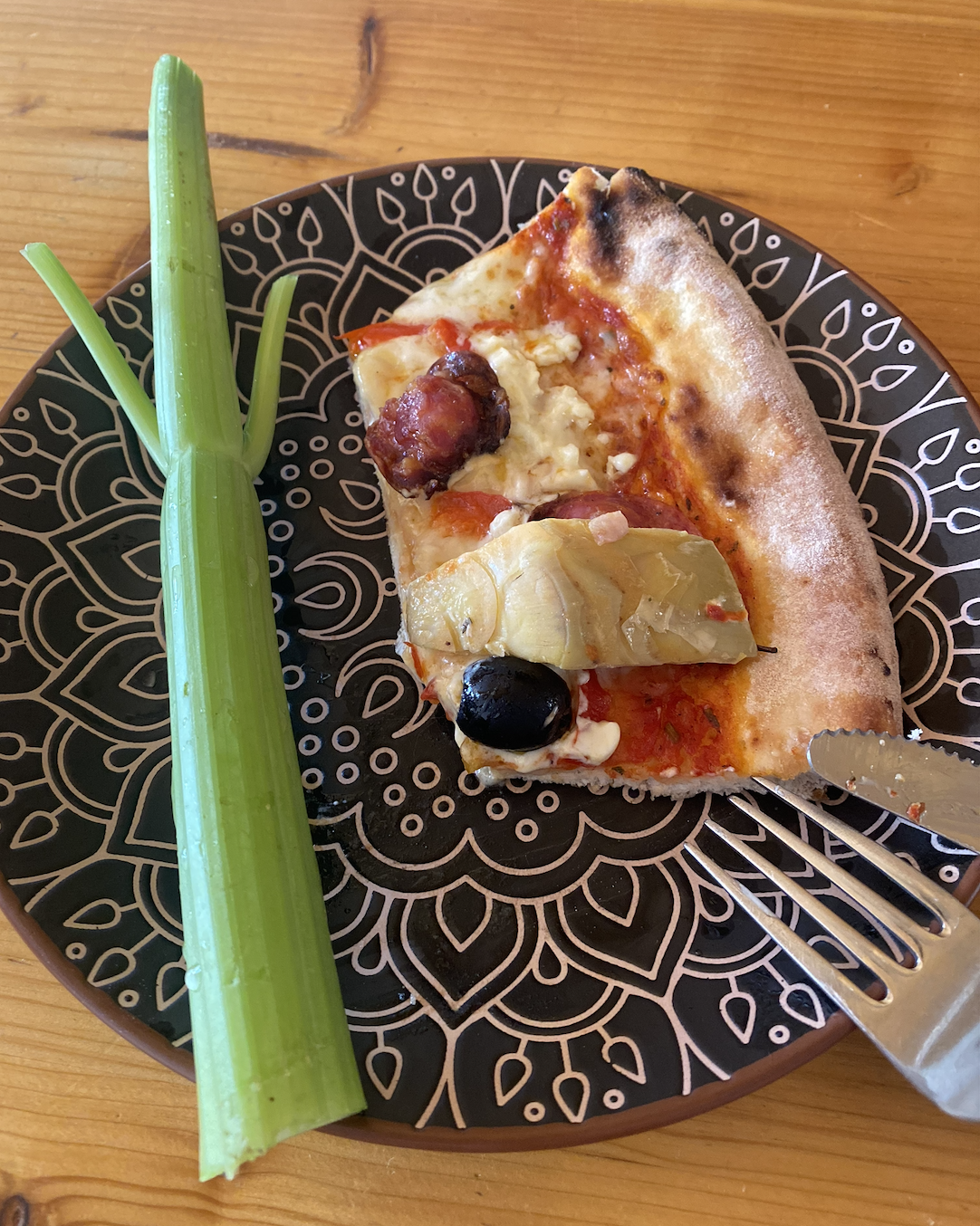
This was my lunch a few days ago: leftover pizza and a stick of celery.
What the absolute fuck.
I would have never been caught dead eating any part of this just a few months ago. My “carnivoresque,” liver-eating, gluten + dairy free, co-op worshipping, farmer’s-market-junkie, eat-like-our-ancestors self would NEVER. NEVER.
That part of me is still very much alive. It never left, but it’s taken a backseat — somewhat unwillingly. It kind of had no choice.
Living just 20 minutes from the border with northern Italy, everyone here seems to know their pizza order. And I know why: the pizza is delicious. Homemade dough rolled out to just the right thickness, topped with tradition, then slid into a giant wood-fired oven. I think I’ve eaten more pizza — and absolutely more cheese — in the last four months than I have in the entirety of the last ten years of my life. Not even exaggerating.
Come on, I live in the Alps in Switzerland — I could throw a stone and hit a cow or a farmer crafting the most creamy, raw, flavorful cheese imaginable. I’d be crazy not to indulge a bit.
And trust me, I’ve indulged.
This is a story about food, culture, adaptation — and doing your best. It is not a post about what to eat.
A Bubble
I always came back to Northern California from my travels saying, “We have access to the best food in the world.”
I still think that’s true to a degree.
The amount of organic farms, local products, and people passionate about biodiversity, regenerative agriculture, permaculture and sustainability is unmatched. Of course, drive down Highway 5 and you’ll get smacked in the face with the smell of factory farms and all the inhumanity that comes with that. But Northern California — especially the Bay Area bubble — is special.
Head up the coast into Oregon and Washington and you’ll find more sweet co-ops and food sanctuaries. One of my favorite stores ever is the Ashland Food Co+Op in Ashland, Oregon. It’s a girl like me’s wet dream. I love the West Coast.
Where’s the Vanilla Extract?!
Being here, though — in a completely new country — has shown me something deeper.
The foods and products we call “good,” “bad,” or “healthy” are often tied to something far more emotional: familiarity.
It wasn’t that I couldn’t find the brands I was used to — I’ve traveled extensively, and I never expect to see the same labels everywhere. What surprised me was the mindset I bumped into, the quiet, subtle expectations I didn’t know I had.
Suddenly I’m in the baking aisle thinking,
Okay… where’s the organic, regeneratively farmed Madagascar vanilla extract?
Instead, I’m staring at rows of “Bourbon Vanille Zucker” packets — little sachets of perfumed vanilla sugar that remind me of the low-quality McCormick stuff from childhood.
(Here it’s Dr. Oetker. And trust me, it’s everywhere.)
Eventually I found a whole vanilla bean… and one Rapunzel brand extract that was bio and fair trade, which made me exhale a little. But still — the options felt different, foreign, unfamiliar.
And that’s when I realized:
It wasn’t disappointment I was feeling.
It was disorientation.
Maybe it wasn’t that the food was lower quality — maybe I just hadn’t learned yet what was considered “good” here.
It’s wild how much of what we believe to be “high quality” or “healthy” is simply what we’ve been marketed to believe back home. The familiar becomes the standard, even when it’s not universal.
Where Ancient Food Culture Meets Modern Corporations
What I’m also noticing is how older, land-based food traditions here sit alongside modern commercial brands. You can buy raw alpine cheese made two valleys over… and right next to it, the same packaged products you’d find anywhere in Europe.
It’s like time has layered itself in this place — ancestral food culture living quietly with globalized convenience.
And it’s not that I’m pretending they’re equal — one is better. Cheese made from our friend’s goats here tastes alive; factory-made cheese tastes like a distant memory of what cheese once was. But that’s exactly the point: geography, history, and economics shape what ends up on our shelves.
Here in the Alps, the mountains created a kind of natural buffer, so outside influence arrives… slowly.
That slowness preserves something important:
identity, continuity, and connection to the land
— the very things much of modern food culture has lost.
It’s a fascinating in-between. And being here has made me realize how deeply our food systems and our histories are intertwined, whether we’re aware of it or not.
Softening Into Another Way
As the months go by, I’m softening. I’m learning to appreciate foods and products that, a few months ago, would’ve never met my “standards.” I’m realizing that familiarity and quality aren’t always the same thing — and that letting go of those internal hierarchies is actually freeing.
And the more I notice this in food, the more I see it in culture, too.
We tend to label what we don’t understand as odd or less than, when really, it’s just not familiar yet.
The cultural anthropologist in me can’t help but see it this way. What makes this little pocket of the Alps so special is how inseparable food and culture are. The rhythm of the seasons here is mirrored by the rhythm of food and celebration.
Winter brings Raclette and Fondue — cheese, potatoes, and more cheese.
Summer brings alpine herbs, flourishing gardens, and… yes, still cheese. There is always cheese.
Everything here moves with the land. And I’m learning — slowly, sometimes reluctantly — to move with it too.
Mindset: The Missing Nutrient
And so, what I’m learning — what I’m living — is that maybe the most important element of nutrition is not just what we eat, but how we think about it.
Mindset.
Now, I still believe what we put in and on our bodies is imperative. But I’m starting to work with the notion that mindset is equally important.
Thoughts are potential creations — what we think, we become.
If I eat a slice of pizza and immediately feel guilt or anxiety, my body doesn’t register nutrients; it registers stress.
And stress, more than gluten or dairy, is one of the greatest toxins in our modern world.
That doesn’t mean we just eat whatever the hell we want and call it spiritual growth — reality still matters.
But so does grace.
The Privilege in Wellness
It’s also impossible to ignore that access to clean, unprocessed, organic food is still a privilege.
Not everyone has the time, resources, or education to eat the way Instagram wellness culture tells them they “should.”
When my husband and I visit California now, we’re overwhelmed by the options. The labels, the buzzwords, the relentless marketing: organic, dairy-free, gluten-free, plastic-free, grandmother-spirit-approved.
That’s where I come from — a land where food is practically a religion.
But go almost anywhere else in the world and it’s different.
To my husband, it’s comical.
He’ll look at a menu and say,
“Can I just have a pizza please? Without cream from a Saharan camel and toasted jujubes marinated in an Arabian prince’s blood? Just… pizza.”
Freedom, Not Perfection
Celery is not a superfood in my opinion.
Neither is pizza.
But you know what? I’m okay with that.
I’m okay with doing my best and allowing things — people, cultures, and seasons — to be as they are. Including myself.
Will I make better choices in the future? Probably.
But I’m not going to punish myself for having food on the table and a full stomach today.
It’s extremely hard to live in this world and not be in it — not be influenced by what’s available, by where we are, by the sheer logistics of life.
Sometimes you won’t have the perfect water, the cleanest ingredients, or the right mineral ratio.
But you’ll have a moment of nourishment.
And that matters too.
You’re Gonna Be Okay
There’s a big world beyond our bubbles.
So have the slice of cake.
Eat the pizza.
Taste the culture you’re in.
Maybe the better question isn’t “Is this food healthy?”
but “How do I feel right now?”
Do I need to move my body, breathe fresh air, connect with someone I love, or simply enjoy being here?
I don’t have a “go-to pizza order,” or at least I didn’t.
But guess what?
Now I do.
Spicy salami, olives, artichokes, and mascarpone, please.
Guten Appetit,
Bridgette Joy